Your First Gallery Visit: A Slow Route Through One Room
Make your first gallery visit easier by choosing one room, looking closely at one artwork, and leaving with a question that stays with you.
The most common mistake on a first gallery visit is trying to see every room. You leave with tired feet, a blur of images, and little sense of which work held your attention. A slower route through one gallery room gives you a manageable way to look, pause, and leave with questions of your own.
You do not need an art-history vocabulary or a fixed interpretation. Treat the visit as time spent with objects in a shared space. Use the route below as a set of choices; adapt it to the room, your energy, and any access needs.
1. Choose One Room
At the entrance, check the gallery map or room labels and choose a space that draws you in. It might contain paintings, photographs, sculpture, textiles, or a mix. Pick a room you can enter without feeling obliged to continue through the whole building.
If the gallery is crowded, look for a quieter room or a stretch of wall where visitors can move freely. Notice practical details too: a bench, clear path, doorway, or place to set down a coat. You can ask staff about seating, accessible routes, or room rules before settling in.
Once you choose, let the rest of the building wait. You can visit another time without treating this one as incomplete.
2. Take In The Room
Before choosing an artwork, stand where you can see the room as a whole. Notice the arrangement: are works hung in a line, grouped together, or separated by open space? Look at how the room’s light, wall color, labels, and sightlines shape what catches your eye.
You are not searching for a hidden message. This first pause simply gives you a sense of the setting. A small work near a doorway may compete for attention with a large work on the far wall; a sculpture may change as people move around it.
Then walk at an easy pace along a route that leaves space for other visitors. If a work is crowded, keep moving and come back when you can see it comfortably.
3. Pick A Work
Choose one artwork because something about it holds your attention, even if you cannot explain why. Perhaps the colors feel unusual together, a shape seems familiar, a subject raises a question, or you simply keep looking back at it. You do not have to select the most famous or largest work.
Try standing at a distance that lets you see the whole piece without blocking anyone. Then adjust your position if the room allows. A work can feel different from across the room than it does nearby, and a sculpture may invite looking from more than one side.
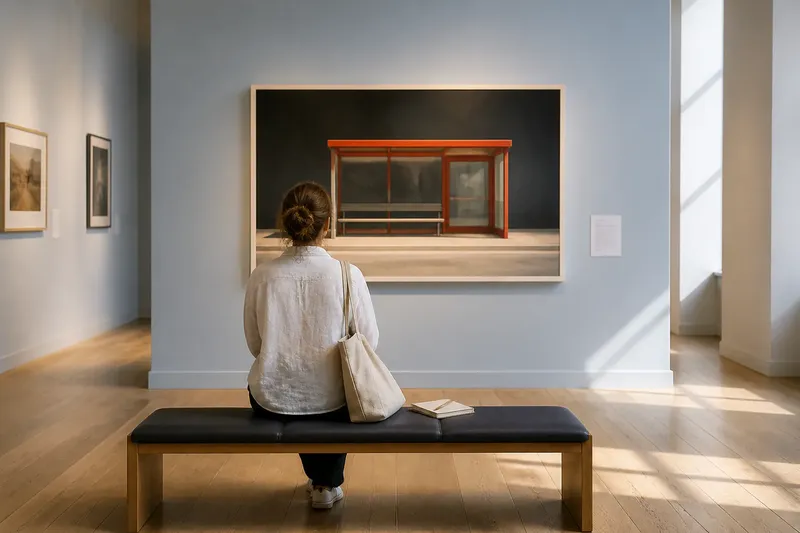
Say you enter a room of photographs and keep returning to one image of an empty bus stop. You choose it because the bright shelter stands out against a dark background. Looking closer, you notice a reflection in the glass that you missed from across the room. That change gives you a specific detail to wonder about, without requiring you to solve the image.
4. Look In Passes
Instead of trying to understand everything at once, look in a few passes. Start with the broad impression: what kind of scene, object, or arrangement do you see? Next, notice a detail that attracts you. Then look for a detail that complicates your first impression.
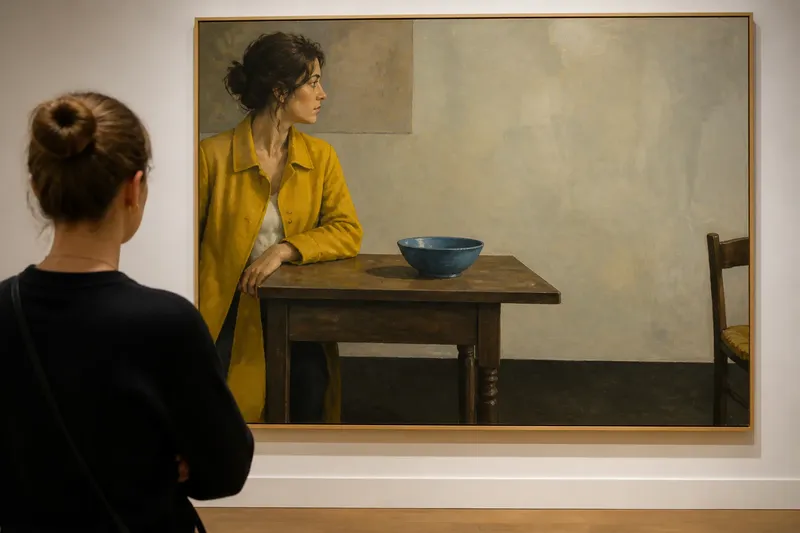
For a painting, you might notice a figure at first, then a narrow strip of color at the edge, then a gap between the figures. For a sculpture, your first impression may shift when you see its back or notice how it occupies the floor. These are prompts for observation, not rules for reading every artwork.
Keep your attention on what is actually visible. If you begin imagining a story, ask which features prompted it and which parts remain uncertain.
5. Read The Label
After looking for a while, read the wall label if you want more context. A label may give an artist’s name, title, materials, date, or a short account of the work. Notice which information changes your understanding and which leaves your original response intact.
You can also choose to look first and read afterward. That keeps the initial encounter open to your own observations, while the label can later offer names or context you did not have. Neither order is the correct one.
If a label gives unfamiliar terms, do not let them turn the visit into a vocabulary test. Hold on to the details you noticed yourself, and return to the artwork rather than trying to memorize every line.
6. Keep Questions In View
What if I do not understand the artwork?
You can notice what is present without arriving at a single meaning. Ask what drew your eye, what feels unclear, and what you would like to know; uncertainty is a workable response.
How long should I stay with one work?
Stay while you are curious, then move on when your attention is ready. There is no required duration, and a brief pause can be more useful than forcing yourself to remain.
Can I take notes or photos?
Check posted rules or ask gallery staff before taking photos, since permissions vary by room and artwork. A few handwritten words in a notebook can capture a question or detail without interrupting your looking.
What if the room is busy?
Give other visitors room, wait for a clear view, or choose another work temporarily. You can return when there is space rather than competing for a perfect position.
7. Write Personal Questions
Jot down a few observations in your own words. Keep them concrete: “The red shape seems to press against the frame,” “I noticed the empty chair last,” or “The title makes me reconsider the setting.” Those notes preserve what you saw without requiring a polished interpretation.
Turn one observation into a question. What might the empty space change? Why does one material feel different from another? What would you like to ask the artist or a gallery educator? A useful question can remain open; you do not need to resolve it before leaving.
If writing would pull you away from the visit, hold a phrase in mind and record it afterward. Your notes are there to support attention, not to create an assignment.
8. Leave With A Thread
Before leaving the room, look once more at your chosen work. Notice whether your attention has shifted from your first impression, or whether the same detail still draws you back. You might also glance around the room and see if another work now raises a related question.
Decide whether you want to spend a little longer, move to another room, or end the visit. Any of those choices can make a complete gallery visit. If you continue, carry one question with you rather than a demand to cover the whole building.
A first gallery visit does not need a grand interpretation to matter. This slow route through one room gives you a concrete way to notice, choose, and wonder. The most useful thing to take home may be a question you would not have thought to ask before you stopped.