The First-Person Trap: What a Narrator Can and Cannot Tell You
Learn how to read a first-person narrator without mistaking a character’s viewpoint for the story’s wider evidence, using a focused routine you can repeat.
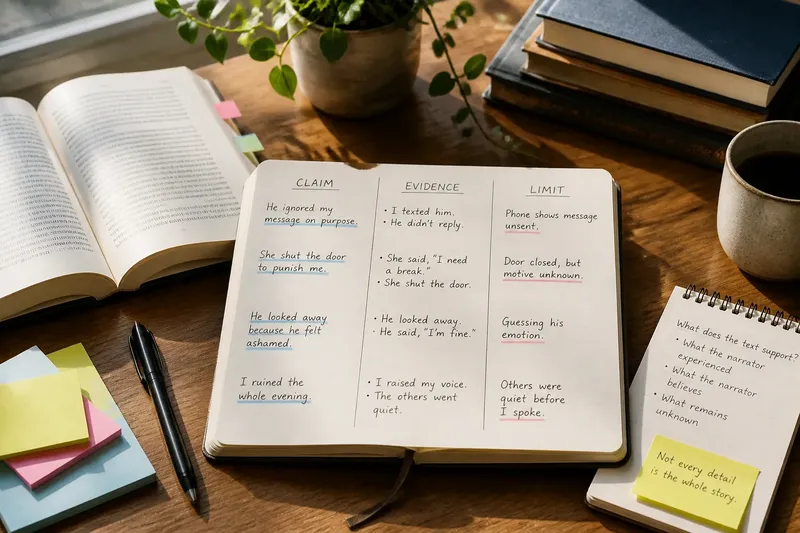
The common mistake in reading a first-person narrator is to treat the speaker’s account as the whole story. That can make a confident interpretation look settled when the narrator has left out a detail, misunderstood a motive, or chosen to mislead. A short reading routine helps you separate what the character says from what the story lets you see.
First person gives a reader access through a character’s voice, not an all-purpose view of events. The narrator may be honest about what they remember and still be wrong about what another person intended. The useful question is not simply “Can I trust this person?” It is “What kind of claim is this, and what evidence supports it?”
A Week of Close Reading
Use one short story or a few chapters of a novel over a week. Keep a notebook or a document with three columns: Claim, Evidence, and Limit. You do not need to annotate every sentence. Choose moments where the narrator makes a judgment, reports a conversation, or explains an important event.
- Day one: Read a complete scene without stopping. Note the narrator’s main account of what happened and the mood they create.
- Day two: Revisit the scene and mark statements of fact separately from interpretations. “She shut the door” reports an action; “she shut it to punish me” assigns a motive.
- Day three: Track what the narrator knows directly. Mark what they saw, heard, remembered, inferred, or learned from someone else.
- Day four: Look at other characters’ words and actions. Record details that support, complicate, or contradict the narrator’s account.
- Day five: Examine a gap, change of subject, or unusually certain explanation. Ask what the narrator has not established, without assuming the omission proves deception.
- Day six: Reread the scene’s ending. Check whether later information changes the meaning of an earlier claim.
- Day seven: Write a brief judgment that distinguishes what seems established from what remains uncertain.
Keep the notes tied to the text. A narrator’s nervous tone may shape your response, but it does not by itself establish that the narrator is lying.
Claims and Evidence
Separate observable events from conclusions about them. A first-person narrator can report an action accurately while interpreting it poorly. If the speaker says, “He looked away, so he must have felt ashamed,” the glance is the reported event; shame is the narrator’s inference.
That distinction matters because fiction often lets readers notice what a character cannot. Another character may deny an accusation, a repeated gesture may conflict with the narrator’s explanation, or a later scene may reveal information the narrator lacked. Treat each detail as evidence with a limited reach. A denial proves that someone denied the claim, not necessarily that the claim is false.
Say you are reading an invented story in which a narrator says a friend ignored a message out of spite. The text also shows that the friend never received it, because the message remained unsent on the narrator’s phone. The action of composing a message is visible evidence; the claim about spite is unsupported. Your conclusion should be narrower than the narrator’s.
Access and Blind Spots
A first-person narrator has a particular position in the story. They can usually report their own thoughts and sensations, but other people’s inner lives reach the reader through speech, behavior, or the narrator’s interpretation. That boundary does not make the narration defective. It creates a point of view the reader must account for.
Notice whether the narrator was present for an event, heard about it later, or is reconstructing it from memory. These are different kinds of access. A remembered conversation may preserve its general shape while losing exact wording. An account based on hearsay may be accurate, but the story gives you fewer grounds to judge it.
Also distinguish a narrator’s limited knowledge from deliberate deception. A child, a frightened witness, or a character overwhelmed by grief may misunderstand events without intending to mislead. Look for signs of motive before calling a narrator unreliable: an admitted lie, a conflict of interest, a self-protective excuse, or repeated contradictions can matter more than an eccentric voice alone.
What Does the Text Support?
Is a first-person narrator always unreliable?
No. First person describes who tells the story, not whether the account is truthful. Judge particular claims by the narrator’s access, the surrounding details, and any contradictions the text supplies.
How can I spot an unreliable narrator?
Look for a meaningful gap between the narrator’s explanation and the story’s evidence. Repeated contradictions, concealed motives, or corrections from other characters can signal that the account needs scrutiny, though no single clue settles every claim.
Can a narrator be honest but mistaken?
Yes. A narrator may faithfully report a memory while misunderstanding what another person meant. Separate what the character experienced from the explanation they attach to it.
What should I do when the evidence is incomplete?
Keep the uncertainty open instead of forcing a verdict. State what the text establishes, what the narrator believes, and what remains unknown.
A Fairer Judgment
When you finish the week’s reading, sort your notes into three groups: claims supported by direct detail, claims that depend on the narrator’s interpretation, and claims the story leaves unresolved. This avoids two easy errors: believing every sentence because it is spoken in first person, or treating every limitation as proof of a lie.
Then write a sentence about the narrator’s reliability that names its scope. “The narrator accurately describes the argument but may misread the friend’s silence” is more useful than “The narrator is unreliable.” It leaves room for the speaker to be credible about one event and uncertain about another.
The first-person trap is not that a character speaks directly to the reader. It is the assumption that direct access means complete access. As you read, return to the main search question—how reliable is a first-person narrator?—and answer it claim by claim. The story’s wider evidence may correct the narrator, support them, or leave you without a final answer; recognizing which is part of reading closely.