From Masks to Modern Stages: A Brief History of Disguise in Theatre
The history of disguise in theatre shows how masks, costume, and concealment shape a role. Learn what to watch for in a performance today.
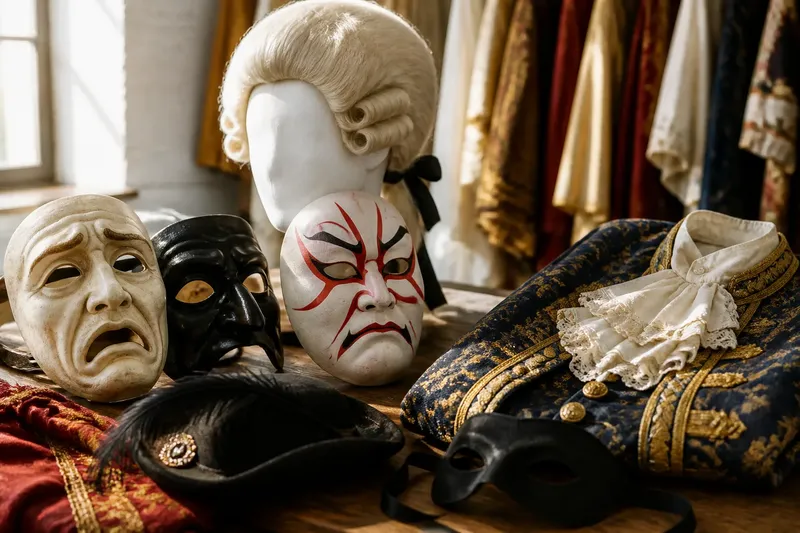
The most common mistake when watching disguise in theatre is treating a mask or costume as decoration. That misses what the performer is doing with it: a changed face can make a role legible from far away, while a concealed identity can turn every entrance into a question. Follow the history of disguise in theatre by watching how each tradition puts the actor’s body, face, and social identity to work.
Start with the visible face
In many early theatrical traditions, a mask made character readable to an audience gathered at a distance. A fixed expression could signal a broad emotional or social type, while a distinctive silhouette helped a figure register across an open performance space. The mask did not simply hide the actor. It supplied a public face for the role.
Greek tragedy and comedy are strongly associated with masks, though theatrical practices varied across periods and performances. The mask’s scale and shape could make a character’s identity easier to recognize, and its stillness asked the actor to communicate through other means. Posture, gesture, voice, and movement carried expressive work that a changing face could not.
As you watch a masked performance, notice the performer’s head angle and the direction of the body. A small turn may stand in for a facial reaction; a change in stance can distinguish one role from another. The mask limits expression in one place and concentrates attention elsewhere.
Look first at what the performer’s body does when the face stays still.
Read the costume’s code
Costume can disguise a performer, but it can also tell the audience how to read a character before the first line. A robe, uniform, or exaggerated accessory may mark rank, occupation, age, or allegiance. These signs depend on the conventions of a particular production and culture. The useful question is not simply “What is the character wearing?” but “What does this clothing let the audience assume?”
In commedia dell’arte, a family of Italian comic performance traditions, masks and recognizable costume elements helped establish recurring character types. The audience could respond to a familiar figure’s established habits while also watching how a performer varied them. A costume might announce a role, but timing, physical comedy, and interaction made that role active.
Shakespearean stages offer another practical case. In the period’s professional theatre, women’s roles were performed by boys or men, so the visible performer and the character’s gender did not align in the modern sense. Plays could then layer disguise within the story: a character might adopt clothing associated with another gender, and the audience could track both the role being played and the actor beneath it. That double awareness made disguise a source of comic tension, uncertainty, or dramatic irony.
When costume signals a social identity, watch for the moment the character changes clothes—or refuses to.
Follow the concealed identity
Disguise becomes a plot engine when a character is mistaken for someone else, hides a name, or moves through a social space under an assumed identity. Costume gives the deception a visible form, but the audience often knows more than the characters do. That gap creates suspense: each encounter tests whether the disguise will hold.
Pay attention to how a production distributes knowledge. Does the audience see the transformation before other characters do? Is the disguise obvious to viewers but invisible to the people onstage? Or does the performance keep the identity uncertain for everyone? Blocking, lighting, voice, and the timing of entrances can help control those answers.
Say you are watching a comedy in which a character enters in a borrowed coat. If another character recognizes the coat but not its wearer, follow where attention lands: the audience may notice the mismatch before the people in the scene. When the wearer changes their voice or posture, the borrowed garment becomes part of an active performance inside the play, not just a costume change.
Track who knows the truth at each entrance; that is often where the scene’s tension lives.
Notice theatrical transformation
As theatrical spaces and acting styles changed, disguise took forms beyond a full-face mask or a complete costume. A wig, painted face, partial covering, or altered silhouette can change how a performer is read while leaving the face visible. In some traditions, stylized makeup and costume are not attempts at naturalistic concealment. They make a character’s identity legible through a shared visual language.
In Japanese kabuki, for instance, makeup, costume, and movement can work together to establish a role’s character and dramatic force. A bold makeup pattern does not hide the actor in the same way as a realistic disguise; it reshapes the face into a theatrical sign. The performer’s controlled gestures and poses complete that transformation. Watch how the audience is invited to recognize the artifice rather than mistake it for ordinary appearance.
Modern productions often shift between realistic clothing and openly theatrical disguise. A contemporary jacket may locate a character in a recognizable setting, while a visible mask or abrupt costume change reminds viewers that identity is being performed. Directors can use that contrast to ask whether a role is imposed by society, chosen by the character, or sustained by the audience’s willingness to believe.
Notice whether a production asks you to forget the costume or to keep seeing it as part of the performance.
What should you watch for?
What does a mask change?
Watch whether it limits facial expression and shifts attention to voice, gesture, or posture. Also notice if the mask signals a type, a status, or a specific identity within the production’s visual language.
How does costume reveal rank?
Look for differences in fabric, shape, ornament, or how freely a character moves. Then compare those details with the character’s treatment by others; costume can announce authority, but the scene may challenge that claim.
When does disguise become visible?
Mark the moment the audience learns a character’s identity is concealed, and compare it with when the other characters learn the truth. The distance between those moments often shapes whether a scene feels comic, suspenseful, or unsettling.
Can a performer disguise without a mask?
Yes. A changed voice, altered gait, posture, hairstyle, or costume detail can make a role appear different while the face remains visible. Watch for a clear shift in the performer’s behavior, not only a change in clothing.
Compare role and performer
To make the history concrete, choose one scene and observe it in two passes. First, focus on the visual signs: mask, makeup, costume, and the performer’s outline. Then look away from those details and listen to the voice, rhythm, and movement. This simple comparison helps separate the disguise’s material from the acting choices that bring it to life.
Imagine a performer playing a messenger who borrows a noble’s cloak to enter a guarded room. The cloak may persuade the other characters, but the performer can let a quick, cautious step betray the messenger’s unfamiliarity with the role. The expected result is a split reading: the characters see authority, while the audience senses the person underneath. That tension shows how costume and concealment shape a role together.
Keep the question specific: what does the costume enable the character to do, and what does the performer reveal despite it? The answer may change from one scene to the next. A disguise can protect, deceive, parody, or expose the effort required to appear convincing.
Carry the history forward
Across stage traditions, disguise has served more than one purpose. Masks can enlarge expression through the body; costume can announce social position; concealed identity can organize a plot; stylized makeup can make performance itself visible. These forms do not follow a single line from “primitive” mask to “modern” realism. They offer different solutions to the same theatrical question: how can an actor make a role visible to an audience?
Next time you see a costume change, do not stop at naming the garment. Notice who recognizes it, how the performer moves in it, and whether the production wants you to believe the disguise. The history of disguise in theatre becomes easier to read when you treat every mask and costume as an action that changes what a character can show, hide, or claim.