A Painting’s Edges: What to Notice Before the Centre
Use a painting’s edges to trace what it includes, leaves out, and directs you toward, so the centre becomes part of a larger visual decision.
The common mistake with a painting’s edges is to treat them as a border around the real subject. That can hide how much the outer areas control what you notice, and what remains outside the picture. To read a painting’s edges, begin with the frame, then follow the image inward. The route can reveal a composition’s choices before the central figure or object claims your attention.
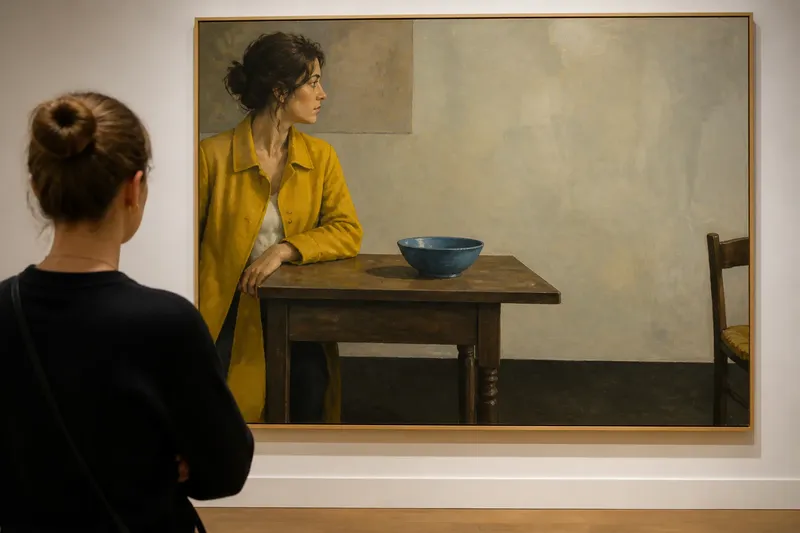
Say you enter a small gallery and stop in front of an invented painting: a woman in a yellow coat stands beside a table, with a blue bowl near the middle. You could look straight at the bowl and move on. Instead, imagine beginning at the lower-left edge and tracing what the painter allows into view. This simple change of route can turn a quick impression into a specific account of how the image is built.
Begin at the frame
Stand at a comfortable viewing distance and notice the painting’s physical boundary. Is it framed, stretched on a deep canvas, or presented with its edges visible? The frame may belong to the artwork’s display rather than its painted composition, so keep the two distinct. Look first at where the painted image ends.
Move your eyes around the perimeter without trying to name the subject. Note where forms touch the edge, stop just short of it, or appear to continue beyond it. A sleeve cut off at the wrist feels different from an arm fully contained in the picture. A branch entering from the top suggests continuation, while a complete tree placed near the side feels more self-contained.
In the imagined gallery, the yellow coat’s elbow meets the left border. The figure is not shown in full, and the crop makes her seem close to the viewer. That detail is easy to miss if you begin with the blue bowl. Ask what the crop makes immediate: intimacy, interruption, movement, or something else? Treat the answer as an observation to check against the rest of the painting, not as a fixed meaning.
Keep your first pass descriptive. “The coat is cut by the left edge” is more useful than “the painter wants me to feel crowded.” The first statement can be checked by looking. The second is an interpretation that needs support from other choices in the image.
Trace the perimeter
Now travel clockwise around the border. At each side, look for three things: shapes that enter or leave, changes in color or light, and areas that remain relatively quiet. You do not need to record every mark. Choose details that change the way your eye moves or the way the scene seems to continue.
- At the top: Does a form appear to continue beyond the picture, or does open space give the image room to breathe?
- At the right: Is there a complete object, a partial object, or an empty area that balances another side?
- Along the bottom: Do furniture, clothing, or ground meet the border in a way that makes the scene feel close or distant?
- At the left: Does the edge cut through a figure, contain a shape, or introduce a new direction into the scene?
In the invented painting, a dark strip runs along the bottom and meets the table leg. At the top, a pale wall continues without a visible ceiling. The right side contains the whole blue bowl’s shadow, though the bowl itself sits farther inward. These details give the eye different tasks: the cut coat presses close, the open wall leaves space, and the shadow leads back toward the bowl.
Notice that an edge can be active without holding a recognizable object. A pale band, a patch of darkness, or a sharp change in brushwork can pull attention just as strongly as a face. If a corner feels unusually forceful, compare its contrast with nearby areas. A bright mark against a dark ground often reads quickly; a low-contrast passage may recede even when it occupies a broad area.
Follow the inward route
After tracing the border, follow the strongest visible connections from the edges toward the centre. Look for lines made by table tops, limbs, roads, shadows, fabric folds, or the direction a figure faces. These do not need to be literal lines. A sequence of repeated shapes or color shifts can also carry the eye inward.
In the imagined scene, the bottom strip meets the table leg, and the leg angles toward the bowl. The woman’s sleeve also points across the table, while her face turns toward the right side rather than toward the viewer. Several paths converge near the bowl, but the picture does not send every route straight to its centre. The bright coat first catches the eye; the quieter table structure then guides attention across the scene.
Try following one route at a time. Start at a corner and name each visible link: dark strip, table leg, tabletop, bowl shadow. If the connection breaks, note where. A broken route can matter. It may make a central object feel isolated, or redirect your attention to another figure or patch of light.
Then reverse direction. Begin at the apparent focal point and trace outward. Ask which edges seem to answer it through color, shape, or direction. This return trip helps distinguish a genuine visual relationship from a path you imposed by scanning in a convenient order.
Notice what stays out
A painted edge is also a decision about exclusion. The image offers a view, but the scene may imply more than it shows. Cropped bodies, cut-off furniture, a shadow with no visible source, or a gaze aimed beyond the frame can suggest an unseen continuation. These clues do not tell you exactly what lies outside. They make the limit itself noticeable.
In the invented gallery, the woman looks toward the right edge, where the painting shows only a pale wall. Her gaze creates a question: is someone or something beyond the picture, or is she simply looking across the room? The image does not settle it. The useful observation is that her attention leaves the painted space, while the bowl gives the viewer a clear object to inspect within it.
Separate a visible absence from an imagined story. You can say, “Her gaze points past the right edge,” without deciding that she is waiting for someone. You can say, “The table continues out of view,” without inventing what else is on it. This restraint keeps interpretation tied to what the painting actually offers.
Look for what the picture makes difficult to see, too. A dark object may merge into the background. A pale form near a pale edge may nearly disappear. The painter may have given the centre sharp detail while leaving outer areas loose, or used similar colors to make the border feel continuous. Those choices affect how much certainty the scene allows.
Compare edge and centre
Return to the central area only after you have mapped the perimeter and its inward routes. Ask whether the centre receives the strongest contrast, the clearest outline, the richest detail, or simply the most convenient position. A central object is not automatically the focal point. A bright shape at the margin can compete with it, while lines from the perimeter can make an off-centre figure feel dominant.
In the imagined painting, the blue bowl sits near the middle, but it is not the brightest object. The yellow coat draws the first glance. The table leg and sleeve then lead toward the bowl, and its shadow connects it to the dark lower strip. The bowl becomes important through a network of relationships, not location alone.
Try a brief comparison: cover the centre with your hand without touching the artwork, then look at the remaining margins. Notice which colors and directions still seem to point inward. Then uncover the centre and check whether those routes find a destination. Do not use this as a verdict about the painter’s intention. It is a way to see how the outer areas prepare, delay, or complicate the central view.
If the image is behind glass or the gallery is crowded, do not lean close or block other visitors. A few steps back can make the perimeter easier to see as a whole. Follow the museum’s directions for viewing and keep a clear path for others.
Questions about painting edges?
Why do artists crop figures?
A crop can make a figure feel close, suggest movement beyond the frame, or make the scene seem like a view taken from a particular position. Read it alongside the figure’s direction and the surrounding space rather than assigning one meaning automatically.
Does the frame count as part of the composition?
The physical frame and the painted edge are related but distinct. Begin with the boundary of the image itself, then consider whether the frame’s color, width, or placement changes how the work is encountered.
What if the edges seem empty?
Quiet areas still shape attention by giving stronger marks room to stand out or by allowing the scene to continue without interruption. Compare their colors, tonal shifts, and space with the busier areas before treating them as irrelevant.
Should I interpret what lies outside the picture?
You can consider possibilities, but keep them separate from what is visible. Describe the clues first, such as a gaze aimed beyond the border or an object cut off by it, then decide how far the evidence supports an interpretation.
Keep the reading grounded
For another painting, use the same order without turning it into a rigid formula: notice the physical boundary, trace the perimeter, follow connections inward, identify implied space beyond the image, and compare those routes with the centre. If you take notes, use two columns—one for visible details and one for possible interpretations. That separation makes it easier to revise an idea when another part of the composition complicates it.
In the invented gallery, the final account is more precise than “the bowl is the subject.” The coat’s cropped elbow brings the viewer close; the blank upper wall leaves open space; the figure’s gaze crosses the right edge; and the table structure leads back to the bowl. None of those observations settles a single meaning. Together, they show how inclusion, exclusion, and direction shape what the viewer can notice.
Use the edges of a painting as evidence, not as a code to crack. The next time a centre seems obvious, pause at one corner and ask what the picture lets in, what it cuts away, and where it sends your eye. That pause often reveals the composition’s most useful decisions.